Hola! I’m Ixchel Lunar (they/them), an Indigenous-Time ecologist, ancestral medicine guide, and rhythm witch for creative rebels, decolonial dreamers, and neuroqueer visionaries. This Substack is dedicated to weaving business, body, and belonging into something no empire can replicate. Still punk as fuck. Still cozy in the chaos.
:: UPDATES ::
ABIDE Workshop — April 13 This is the live version of CONTINUUM. We take your cosmological map off the page and into the body. If you’ve been sitting with your reading and want to go deeper, this is the room. Reserve your spot here → (or become a Founding Wildling and get monthly access!)
Upgrade to Founding Wildling + ABIDE
CONTINUUM Your Vitality (Fortune) and Direction (Spirit/Daimon) mapped to your natal lunation. This is where the on-ramp starts (it’s included with the Workshop when you register for ABIDE). A written reading built for you→
Stellar Impression Mentorship For established creatives, founders, and practitioners ready to build a brand that the market has to catch up to. The reimagined mentorship is open. If you’ve been circling this, now is the time to apply. Explore Stellar Impression →

Beautiful Wildling,
My compost pile is escaping.
It sits on a hill outside my kitchen window, here in Mexico. I watch it from where I make my coffee. Apple cores. Bits of brown avocado that did not make it to the bowl in time. The birds know it’s there. They come and pick. The chachalacas and brown jays make a big fuss when it’s empty and then leave.
The soil at the back has been slowly sliding downhill for weeks. It needs reinforcing. Or maybe it needs to be moved entirely to flat ground where it stops escaping and starts actually building.
I’ve been thinking: that spot on the hill, once the compost moves, could hold a bird bath and a platform for fruit and seed. A small reciprocity station. The birds are already in a relationship with that corner of the land. I’d be committing to something that’s already happening.
That’s how food systems are supposed to work.
I got deep into this in Sonoma County. Years of it. Teaching people how to compost. Walking people through food forest design. Sitting on regional bodies making policy about waste diversion, landfill alternatives, and composting infrastructure. I helped write plans to redirect 90 percent of waste, including all organic waste, from landfills into soil-building programs. It was some of the most grounded policy work I’ve done.
And here I am watching black gold escape down a hillside outside my window.
The polycrises are not separate.
We talk about them like they are. The war. The food system. The supply chain. The climate grief. The economic pressure. We categorize them because that’s what colonial administration trained us to do: break the whole into manageable departments, assign each a bureaucracy, and then wonder why nothing heals.
They are not separate.
The New Orange Order’s war on SWANA is a food crisis. Not metaphorically. Literally. Sudan, Gaza, South Sudan, Yemen, Haiti, Mali, Afghanistan: agricultural land destroyed, farmers displaced, grain and fertilizer supply routes severed. The UN World Food Programme projects 45 million more people could be pushed into acute hunger this year if the conflict continues. That is on top of 318 million already food insecure. We are downstream of that. The food anxiety many of us feel right now, the rising prices, the gaps on shelves in certain communities are not abstractions. It is the direct material consequence of war on farmland.
When we sever people from land, we sever food from its source. That is not new. It has been colonial policy for five hundred years.
The compost pile escaping down the hill is a small version of the same thing. Relationship interrupted. The loop is broken.
The Orange Order ran this before. An Gorta Mór. The Great Hunger. Food was leaving Ireland by the shipload while a million people starved. The blight took one crop. The Order took the rest. We know what this is.
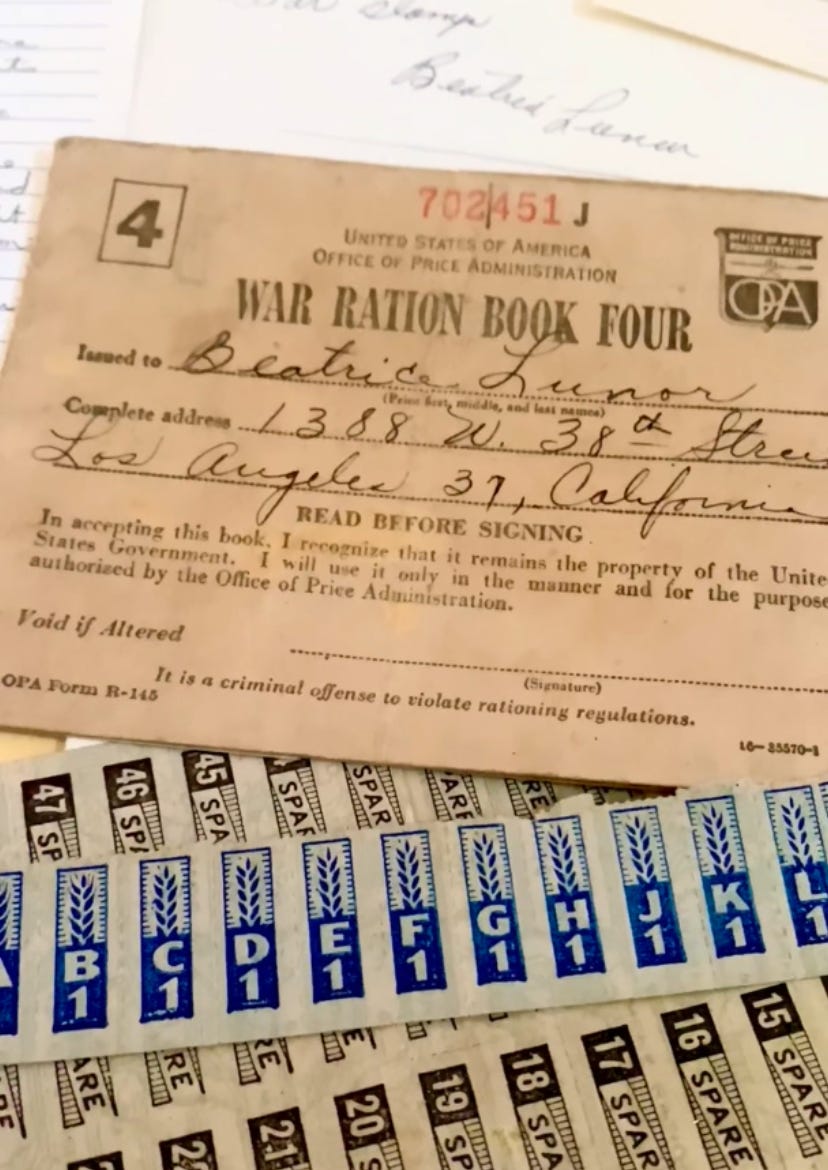
My abuelita kept everything.
Every rubber band. Every twist tie. Every piece of foil was washed, folded, and refolded until it was as soft as cloth. We spent years trying to help her sort and downsize. She could not throw anything away on her own.
One time when going through her things, we came across her War Ration Book Four. United States Office of Price Administration. Issued to Beatrice Lunar, 1388 W. 38th Street, Los Angeles. The stamps are still attached.
When she explained what it was, it brought chills. She survived the Great Depression. She survived WWII rationing. Her body learned: the food stops. The government controls what you eat. Running out is real.
That learning did not leave when the war ended. It settled into her nervous system and stayed. It became the way she moved through her kitchen, her pantry, her whole life. Her children absorbed it. I absorbed it. Her worry. Her careful folding of things other people threw away.
Her hoarding was not a personality problem. It was her body’s accurate memory.
Dr. Oonagh Walsh’s epigenetics research on An Gorta Mór found that famine survivors passed a hyper-vigilant biological adaptation to their descendants, creating bodies primed for scarcity, reading ordinary stress as a catastrophic threat. Research on both sides of the Atlantic documents cardiovascular, metabolic, and mental health effects lasting three to four generations. Walsh notes the cultural residue, too: the shame of not having enough to feed someone.
I carry this in my own body. I need a stocked pantry. I need to feel resourced. I have tracked that need back far enough to know it is not just mine. It arrived through my Abuelita Bea. Through what the body learned when food stopped being something you could count on.
We carry our ancestors’ food grief. It shows up as urgency without an object. Preparing for something that never quite arrives and never quite leaves.
The New Orange Order is counting on that. A population living in inherited scarcity terror is easier to extract from.

Indigenous food systems did not have a waste problem.
The milpa is not companion planting.
The three sisters, corn, beans, and squash, grown together, are called companion planting when it gets extracted into Western permaculture language. In Mesoamerican practice, the milpa and abix are a whole cosmological food system. It builds soil. It distributes caloric risk across multiple crops so that when one fails, you do not starve. It feeds through drought in ways monoculture cannot. It is designed to be returned to the earth and regenerated across seasons.
The abix, like milpa, but with deep Maya geo-cosmovision, is the food-forest growing system in Maya practice. The harvest is not the end of the cycle. It is the moment the community gathers to mark what the land gave and to begin the reciprocity of preparing for what comes next. Food as ceremony. Abundance is relational, not individual.
These systems did not produce the level of waste we produce because the relationship with what the land gives is different. Nothing is wasted when you are in relationship with the soil.
We broke that relationship on purpose. Colonial food systems required it. It’s really hard to extract labor from a person who is fed by their own land, cosmologically bound, and in relationship to it.

Today is 3 Q’anil in the Cholq’ij, the 260-day Maya sacred calendar.
Q’anil is seed. Germination. The four colors of corn and the intelligence of what wants to grow. The number 3 is internal activation, the first real movement of energy into form. We are inside the trecena of Kame, the thirteen-day period governed by death, transformation, and the ancestors who hold the threshold between worlds. It’s probably one of the most challenging trecenas of the cycle.
Seed energy activating inside an ancestral reckoning.
It’s not a coincidence that this letter is arriving today, with this content, asking these essential questions. The cosmological moment is naming what I am already feeling in my body: something is ready to germinate. Something else has to die for it to do so. And the ancestors are not passive observers of that process.
Q’anil asks: what are you actually planting? Kame asks: what are you willing to compost so the seed has ground?
The coming food crisis will demand the same. In soil and body. Whether we have language for it or not.
Here is what I want to ask of you.
What do you grow, or what could you grow, that someone nearby needs?
I am not talking about becoming a homesteader or building a bunker. I am talking about one thing. One crop. Food or medicine. Many relationships.
Beans are easy and calorie-dense, but need space to grow. Squash can be grown more compactly, and it stores well. Plus, the seeds are rich in micronutrients and antioxidants, regulate blood sugar, are antiparasitic, and antifungal. Herbs have trade value and medicinal weight. If you are in a drought region, there are crops built for that. If you have a small container garden, there are crops built for that, too.
The food gap stemming from the SWANA crisis is real and not going away. The question is whether we respond to it by hoping the supply chain stabilizes or by supporting the local food relationships that colonization severed.
A crop you grow for trading is not a survival strategy. It is a relational one. It says: I am in relationship with this land. I am in relationship with my neighbors. My surplus belongs to the loop, not the landfill.
That is the abix logic. That is the milpa logic. That is the compost pile logic (if you move it to flat ground and stop it from escaping).
Some practical anchors if you want to start:
-
Compost first. If you have no access to land, a small worm bin or bokashi setup feeds a neighbor’s garden. The loop does not require a yard.
-
Research your regional food system. Who are the local farmers near you? What are the gaps in the food web in your area? Community Supported Agriculture shares are one entry point. Farmer’s markets, where you can actually talk to growers, are another.
-
Find one crop that your climate supports, and your body will eat. Choose one that stacks functions. Grow more than you need. That extra is the beginning of trade.
-
Network. Get in your neighborhood text group and find out what others have started growing in surplus, so you can differentiate.
-
Look up your county’s composting infrastructure. Many regions have food scrap pickup or community drop-off. Using it is a direct act of waste diversion. Supporting it politically matters, too.
-
If you are in a city, look for urban farming initiatives, community gardens, or food forests open to the public. They exist in more places than people know.
My compost pile needs attention this week.
I am going to move it somewhere flat so I can use the black gold to grow calabaza.
And I am going to set up the bird bath where the pile was, with fruit and seed, because that relationship with the birds is already happening, and I might as well be honest about it.
If the polycrisis is telling you anything, it is that the systems we depended on were never as stable as we were led to believe. Your body knows this. Your nervous system has been responding to it for years.
The question is whether you have a map.
I am opening Founding Member subscriptions today at $150 a year. You get your personal CONTINUUM written reading, access to ABIDE workshop on April 13th, and all future ABIDE workshops this year, plus the daily energy email tracking the Cholq’ij and lunar cycle, so you stop navigating by colonial clock alone.
Folks who came to the first ABIDE workshop were stoked to have access to the future ones. It’s my offering for monthly gatherings as we navigate this moment.
One door. Open now until the end of April.
Upgrade to Founding Wildling + ABIDE
Stay wild, love fiercely. Your presence is golden.
With wild and rebellious love,
Maltiox! xo Ixchel
P.S. Maltiox pronounced mall-tee-osh means with gratitude in K’iche Mayan.
♾️ ABIDE: Fortune. Spirit. Lunation. April Workshop →
🫧 Join the free 5-day Interrupting Time practice →
👩🏽🤝👩🏾 Ways to work with me…
🎙️ Book me for your Podcast, speaking event, or program…

🌒 Get your Moon Phase (free calculator) →
✍🏽 Meet OoSo Studio →
👩🏽🤝👩🏾 Ways to work with me…
🎙️ Book me for your Podcast, speaking event, or program…
Walk in beauty. Live your magic. Go wild.
Your Sanctuary to Cultivate Wild Presence for Thriving with a Planet in Transition
I was raised and bore children on the traditional, unceded, and stolen lands of the Coast and Central Valley Miwok (colonized as Petaluma, CA) and Nisenan (colonized as Sacramento and Fair Oaks, CA), past, present, and future. I also write, work, and live in the highland forest of the traditional, unceded and stolen lands of the Totonac, Nahua, and Mexicah, past, present, and future, in what is known as Coatepec, Veracruz, Mexico.
P.P.S. I do not live or consent to the colonial impositions regarding the construct of Time. I also practice honoring rhythms of work, play, and rest so that I can serve you with embodied presence and with loving care. This means I may take several days to respond to your requests and questions. (h/t Eva Glamaris)
P.P.S. A mention is not necessarily an endorsement of someone. It’s an acknowledgment, a citation, of the origin of information in my process of understanding. (h/t Kelly Diels)
Thanks for reading! If you loved it, tell your friends to subscribe.
We may include other affiliate links in our content. Thank you for supporting our work.
Copyright © 2026, Cheyenne, WY, and Veracruz, Mexico, All rights reserved. Sharing your lineage of knowledge is decolonial. When iterating, please cite me. Not citing is epistemicide.
